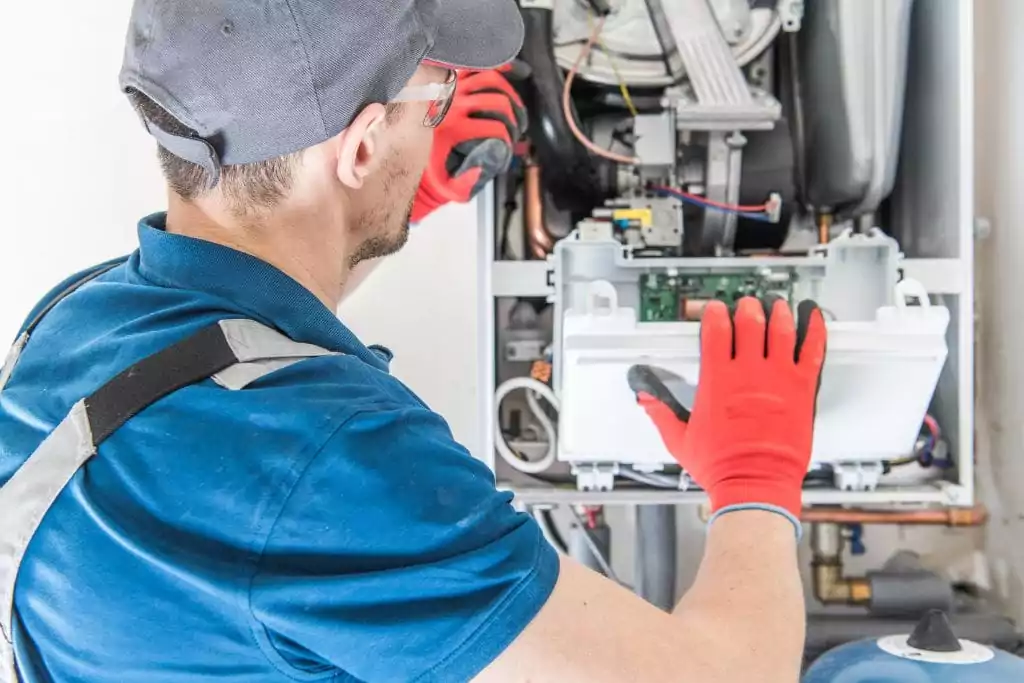
Traditional tank water heaters heat and store water in large storage tanks, keeping it ready until you need it. Tankless water heaters heat water as it flows through the unit, without a storage tank to retain hot water. But you probably knew that much already.
What you likely want to know is if choosing between tankless vs. tank water heater mostly comes down to how much hot water you use and what you’re willing to spend. The short answer is yes. However, there’s more you need to learn before you can confidently choose the right water heater for your home.
Tankless vs. Tank Water Heater Core Differences
| Tank Water Heater | Tankless Water Heater | |
| How it works | Heats and stores water | Heats water on demand |
| Typical capacity | 30–80 gallons | No storage tank |
| Hot water supply | Limited by tank capacity | Continuous within flow-rate limits |
| Typical flow rate | Depends on tank and recovery rate | Usually measured in GPM |
| Upfront cost | Lower | Higher |
| Installation | Usually simpler | Often more complex |
| Energy use | Higher due to standby losses | Generally lower |
| Maintenance | Relatively simple | Requires periodic descaling |
| Lifespan | About 8–12 years | About 15–20 years |
| Best for | Lower cost and simple replacement | Long-term use and high hot-water demand |
How Do Tank and Tankless Water Heaters Work?
A traditional water heater, also called a storage water heater, keeps a supply of heated water inside a storage tank. Cold water enters the tank and is heated by either a gas burner or electric heating element. The hot water stays in the tank until a faucet, shower, or appliance creates demand. As hot water pours out, cold water enters to replace it, and the whole process repeats.
Most residential tank models hold around 30 to 80 gallons, with 40- and 50-gallon models being particularly common. A 40-gallon tank may suit a smaller household, while a 50-gallon tank is often used for households with a slightly greater hot-water demand. Larger 65-, 75-, and 80-gallon tank systems are also available, and are often used by large families.
A tankless water heater unit works differently. When you turn on a hot-water fixture, a sensor detects the flow and activates the heating system. The incoming water passes through a heat exchanger, where it is heated before traveling to the faucet.
In other words, tank systems store hot water, while tankless systems heat up the water as you use it.
Which Water Heater Is More Expensive?
On average, storage tank water heaters are the more affordable ones. And the price difference is quite considerable.
A tank model typically costs less to purchase and install. Current retail examples put basic 40- to 50-gallon tank units at roughly $400 to $900, although higher-efficiency and premium tank heaters can cost considerably more. Tankless ones usually cost 2-3x more.
The same thing applies to installation. A tankless water heater installation usually costs more because the home may need a larger gas line, different venting, additional electrical capacity, or other modifications. On average, installing a typical tank costs around $1,600 to $2,400, while tankless usually cost twice as much.
| Tank Water Heater | Tankless Water Heater | |
| Purchase price | About $400–$900 for many basic 40–50 gal units | About $600–$2,600 for many units |
| Typical installed cost | About $1,600–$2,400 | About $2,400–$5,400 |
| Installation | Usually simpler | Often more involved |
| Infrastructure upgrades | Less likely | More likely |
| Energy costs | Generally higher | Generally lower |
| Maintenance | Usually less involved | May require regular descaling |
| Replacement frequency | Higher | Lower |
How Does Hot Water Supply and Performance Differ Between the Two?
A tank water heater gives you a reservoir of hot water which is often more than enough to handle most daily water needs. The drawback is that the supply is finite. Once the tank’s stored hot water is gone, you have to wait for some time before the water is hot again.
Now, a 50-gallon tank does not necessarily mean you only get 50 gallons of hot water. The cold water mixes with the hot water in the tank while you’re using it, so you do get some extra gallons here. What matters in practice is the unit’s first-hour rating, which measures how much hot water a fully heated storage water heater can deliver over an hour.
Energy Star uses first-hour ratings to compare storage water heaters’ hot-water delivery.
Tankless heaters don’t have the same storage limitation. A properly sized tankless system can provide near endless hot water.
The key word there is “near.” A tankless heater doesn’t have unlimited capacity. Its performance depends on its flow rate, measured in gallons per minute (GPM), as well as the temperature of the incoming water. Energy Star defines GPM for tankless systems based on how much water the unit can heat while maintaining a specified temperature rise.
| Tank Water Heater | Tankless Water Heater | |
| Hot water supply | Stored supply, typically 30–80 gallons | Continuous production |
| Main limitation | Tank capacity and recovery | Flow and heating capacity |
| Back-to-back showers | Can eventually exhaust supply | Better suited to prolonged demand |
| Simultaneous use | Draws from stored water | Must stay within rated GPM |
| Recovery | Requires reheating | Heats incoming water continuously |
| Risk of running out | Higher during heavy use | Possible if demand exceeds capacity |
Why Does Flow Rate Matter?
Flow rate is one of the most important specifications when comparing tankless heaters.
Suppose two showers each use 2 GPM while a faucet uses another 1 GPM. Your household is demanding roughly 5 GPM at the same time.
A tankless unit needs to be able to heat that amount of water to the desired water temperature. If the unit is rated for 5 GPM under proper conditions, it can theoretically handle that demand. If the household requires more than its rated output, the unit won’t be able to maintain the desired temperature and flow.
Another thing that matters for this equation is the incoming water temperature. A tankless heater has to work harder when the water entering the house is very cold. The same unit that can produce a higher GPM at a moderate temperature, will deliver less hot water when it needs to raise very cold water to the same target temperature.
Temperature consistency also deserves a mention. A properly sized modern tankless system can maintain a fairly steady outlet temperature, but it has to continuously adjust to changes in flow and incoming water temperature.
None of this is a consideration for a tank water heater, because it has the benefit of a large reservoir that acts as a buffer during changes in demand.
Which One Is More Energy Efficient?
A tankless water heater is more energy efficient on average. Its main advantage comes from reducing standby heat loss. However, your actual water heating costs depend on hot-water usage, energy prices, fuel type, climate, and the efficiency of the specific unit.
In other words, it’s more efficient than a tank because a tank heater has to maintain the temperature in the tank. Even when you’re not using hot water, heat escapes from the tank, and the heater has to turn on from time to time to maintain the temperature.
Tankless systems avoid this because they don’t continuously heat a large volume of stored water. That can make tankless systems more efficient, particularly in homes with lower or moderate hot-water demand.
The Department of Energy’s commonly cited estimates put tankless savings at 24% to 34% for homes using 41 gallons or less of hot water per day, while homes using around 86 gallons per day may see savings closer to 8% to 14%.
Those percentages refer to energy use, not a guaranteed reduction in your total utility bill. For example, if your household currently spends $50 per month on water heating, a hypothetical 24% reduction would be about $12 per month, or $144 per year. At 10%, the savings would be only $5 per month, or $60 per year.
| Tank Water Heater | Tankless Water Heater | |
| Standby heat loss | Yes | Minimal |
| Heats water when idle | Yes | Generally no |
| Energy efficiency | Generally lower | Generally higher |
| Potential energy savings | Lower | Higher |
| Typical savings at ≤41 gal/day | Baseline | About 24%–34% more energy efficient |
| Typical savings at ~86 gal/day | Baseline | About 8%–14% more energy efficient |
How Do Maintenance and Lifespan Differ Between Tankless and Tank Water Heaters?
Both systems require maintenance, but they have different needs. A traditional tank water heater can provide many years of service with relatively simple maintenance, but the storage tank itself eventually becomes vulnerable to corrosion. Traditional water heaters can also accumulate sediment inside the tank and may require periodic flushing. The anode rod also needs attention because it helps protect the tank from corrosion. Conversely, gas models require appropriate burner and venting inspections.
Tankless water heater maintenance primarily involves descaling the heat exchanger, particularly in areas with hard water. Gas tankless units may also need burner and venting inspections.
A tankless unit doesn’t have that large steel reservoir, which is one reason tankless units can last significantly longer when properly maintained. Some industry and utility guidance puts tankless life expectancy at 20 years or more, compared with roughly 10–15 years for storage systems, although actual life depends heavily on water quality, maintenance, and the equipment itself.
| Tank Water Heater | Tankless Water Heater | |
| Typical lifespan | About 8–12 years | About 15–20 years |
| Main maintenance concern | Sediment and corrosion | Mineral buildup and scale |
| Anode rod | Yes | No |
| Descaling | Not typically required | Often required |
| Maintenance complexity | Lower | Higher |
| Replacement frequency | More frequent | Less frequent |
How to Choose the Right Water Heater for Your Home
There isn’t one right answer for every home. To make an informed decision, focus on these five things.
1. Household Size and Water Usage
Household size gives you a starting point, but your actual hot-water habits matter more. A two-person household that takes long showers and frequently uses multiple fixtures may have greater demand than a four-person household.
To get a good estimate, think about your peak demand rather than just the number of people in the house.
For a tank, that means considering whether you need 40, 50, 65, or 75+ gallons and checking the first-hour rating rather than looking only at tank volume.
For a tankless unit, add up the GPM of the fixtures you expect to use simultaneously and make sure the system can deliver that flow at your required temperature rise.
2. Existing Infrastructure
Your existing setup can have a major impact on the decision. Tank water heater replacement is generally straightforward. Off with the old, in with the new.
Switching to a tankless hot water heater, however, may require changes to gas lines, electrical service, venting, or plumbing, because, for example, a gas tankless unit may need a larger gas supply and dedicated venting. At the same time, it’s worth knowing that electric tankless systems can require substantial electrical capacity because they draw a large amount of power while actively heating water.
To be certain, get an installation quote before deciding if tankless is worth the additional cost.
3. Budget
If you need the lowest upfront cost, a tank system usually wins. But, if you can spend more now and expect to stay in the home for many years, the longer lifespan and lower energy consumption of a tankless model may make the additional investment worthwhile.
Just remember that the difference can be several thousand dollars.
Current national estimates put average installation around $1,950 for a standard tank and about $4,300 for a tankless system, although local quotes can fall well outside those averages.
4. How Long You Plan on Using It
If you expect to move within a few years, the higher cost of a tankless system is honestly difficult to justify. Even with the energy savings, it’s unlikely you’ll recover the money. For example, if a tankless installation costs $2,000 more than a tank and saves $100 per year in energy, energy savings alone would take about 20 years to recover that premium.
On the other hand, if you’re staying for 10, 15, or 20 years, you’re more likely to benefit from its longer service life and potential energy savings.
5. Water Quality and Maintenance
If you have hard water, factor the additional maintenance of a tankless system into your decision.
Regular descaling helps protect the heat exchanger and maintain performance. If you don’t want to deal with that maintenance, a conventional tank may be more practical.
Is a Tankless Water Heater Worth It?
A tankless water heater is worth considering, but it isn’t automatically the better choice.
A tank is a good option because it has a lower upfront cost, simpler installation, and relatively straightforward maintenance. It’s a practical option for households with moderate demand that don’t mind having a limited hot water supply from time to time. Worst case scenario… Someone will wait a bit to take a shower.
On the other hand, a tankless heater costs more initially, but it can provide continuous hot water, reduce standby losses, and last considerably longer.
The best way to figure out if one is better than the other is to compare the actual numbers for your home. Get quotes for both a properly sized tank and tankless system, then compare water heater installation costs, expected energy use, maintenance, and lifespan.
- If you’re optimizing for lower upfront cost and simplicity, choose a tank.
- If you’re optimizing for long-term ownership, efficiency, and continuous hot water, tankless may be worth the investment.
And if after all that you still can’t make a decision on the system, give Pallan Plumbing a call. We’ll crunch the numbers with you, provide you with an estimate, and help you make a decision that’s best for your circumstances.